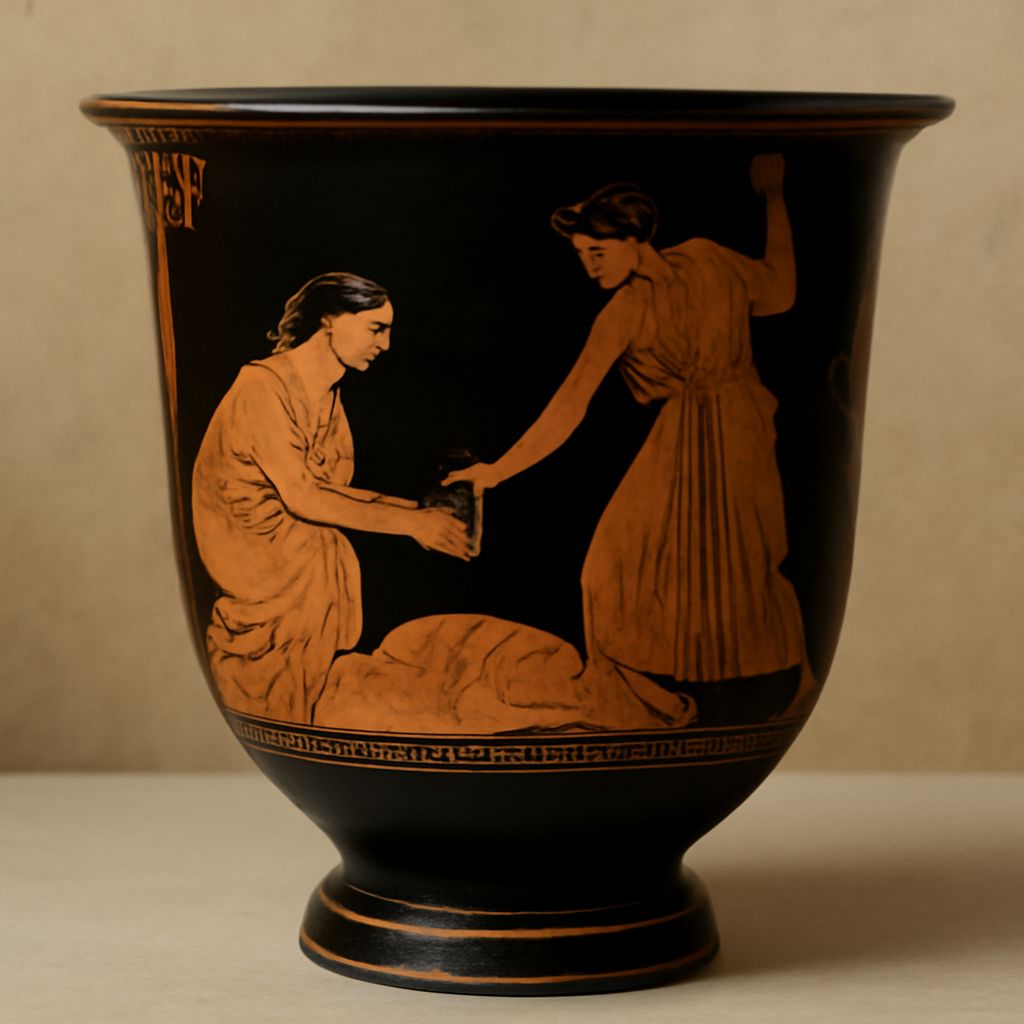
You are reading a scene in which a son stands before his mother with a weapon. He has been told to avenge his father. She reminds him that she raised him. In Aeschylus’s play about the bearers of libations, neither claim can simply be set aside. The choice will answer one killing and create another.
The Libation Bearers is the middle play of the Oresteia, a trilogy first performed in Athens in 458 BCE. Its action grows out of a murder in the first play and drives toward a reckoning in the third. Here is how the return of Orestes and his reunion with Electra set that revenge in motion.
Libation Bearers at Agamemnon’s Tomb
In the first play, Agamemnon, Clytemnestra kills her husband after his return from Troy. Her lover Aegisthus shares power with her. Her reasons include Agamemnon’s sacrifice of their daughter Iphigenia before the war. A murder has a history, and this family has a long one.
In Aeschylus, libation bearers arrive at Agamemnon’s tomb with Electra to pour offerings for the dead. They are captive women who form the chorus. Clytemnestra has sent them after a troubling dream, hoping to address the danger she fears. At the grave, however, Electra and the chorus turn their prayers toward justice for Agamemnon.
Orestes, Electra’s brother, has returned from exile with his companion Pylades. He leaves a lock of hair at the tomb. Electra notices it and sees footprints; Orestes comes forward, and signs including the hair and a woven piece of cloth help establish his identity. Their reunion is emotional, but it is also the beginning of a plan. The Center for Hellenic Studies text gives the scene in Herbert Weir Smyth’s translation.
Read Electra’s discovery as a sequence of questions. Let hope enter before certainty does. When the siblings recognize one another, give their relief room to breathe; the audience knows that the danger outside the reunion has not disappeared.
A Father’s Claim and Apollo’s Command
Orestes tells Electra and the chorus that Apollo has commanded him to avenge Agamemnon and threatened punishment if he refuses. Together they invoke their father and ask for help against the rulers of the house. The chorus supports the siblings’ call for revenge, linking their private loss to a demand for justice.
Duty here has more than one voice. Orestes owes something to his murdered father and is under a god’s command. Yet Clytemnestra is his mother. Killing her would make him responsible for the blood of a close relative. The chorus’s confidence does not make that conflict vanish.
For a vocal performance, distinguish appeal from instruction. The siblings’ prayer can sound urgent without becoming a single uninterrupted shout. When Orestes explains Apollo’s command, try a firmness that leaves a trace of fear beneath it. He has a reason to act, and a terrible reason to hesitate.
The Deception and the Killings
Orestes and Pylades approach the palace in disguise. Orestes reports that Orestes himself is dead. Clytemnestra receives the news, and the old nurse is sent to summon Aegisthus. The chorus persuades the nurse to tell him to come without his guards. Her grief for the young man she helped raise gives the deception a human cost before the violence begins.
Aegisthus enters and is killed. When Clytemnestra understands what has happened, she confronts Orestes and appeals to their bond as mother and son. Orestes falters. Pylades, usually silent, reminds him of Apollo’s command. Orestes then kills Clytemnestra.
Do not play the hesitation as a pause waiting for a cue. It is the moment when two obligations become impossible to satisfy together. Give Clytemnestra’s appeal the force of a person trying to live, not merely the sound of a villain explaining herself. Pylades’s brief intervention changes the action because Orestes must decide what authority to follow.
Victory and the Furies
After the killings, Orestes displays the garment associated with Agamemnon’s murder and defends his act. He presents himself as his father’s avenger and points to Apollo’s support. Then he sees the Furies, pursuing powers associated with the blood of his mother, and leaves in distress for Apollo’s sanctuary.
The play’s revenge has removed Aegisthus and Clytemnestra, but it has not settled the competing claims of family blood and justice. In Aeschylus’s drama of the libation-bearing women, one act of retribution becomes the source of another pursuit. The Eumenides, the final play of the trilogy, takes up that unresolved conflict.