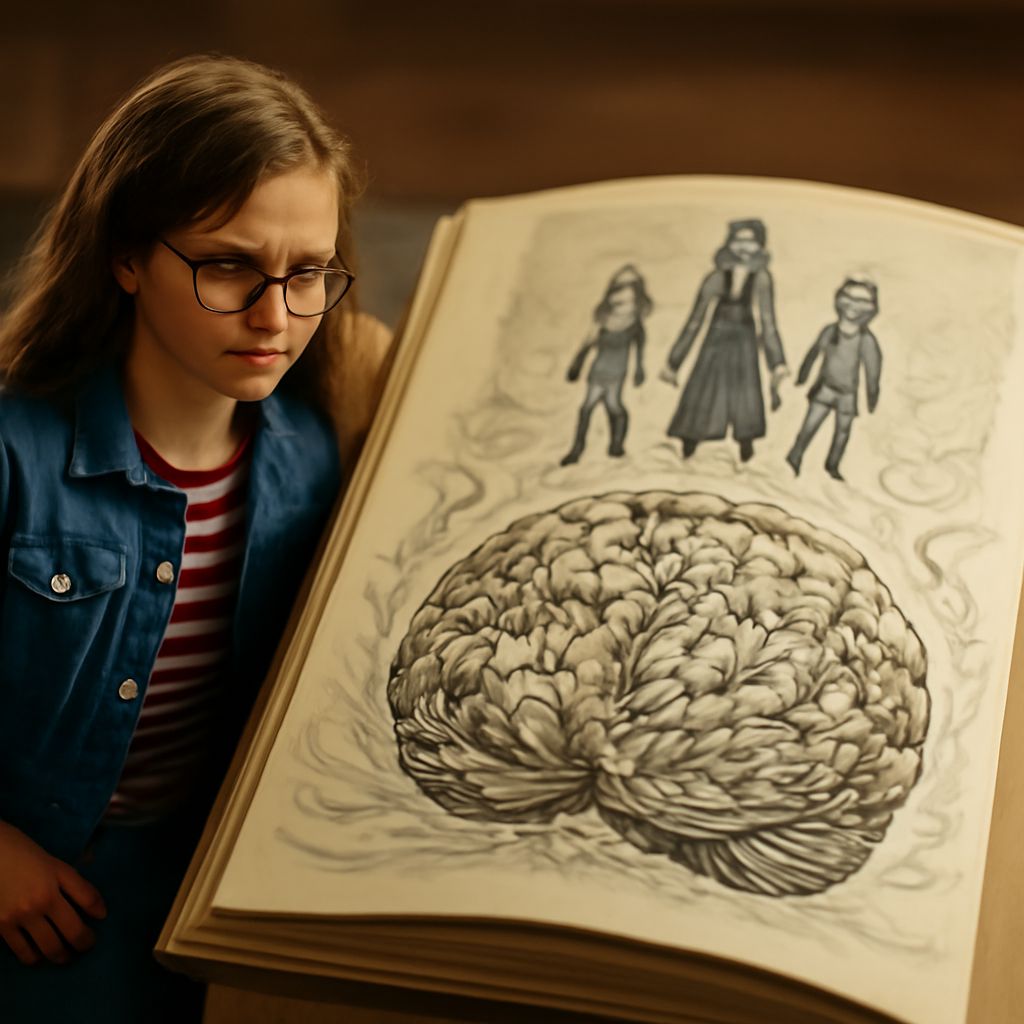
You are preparing a scene in which an injured girl meets a tall creature with tentacles. Should the creature sound frightening? In Madeleine L’Engle’s A Wrinkle in Time, the being Meg calls her Beast aunt offers a better clue through what she does: she carries, warms, and feeds her.
The encounter between Meg and the Beast of A Wrinkle in Time turns first impressions into a lesson in attention. For a reader aloud, the scene offers two changes to track: Meg’s fear gradually gives way to trust, while her caregiver works to communicate across a difference in senses.
Aunt Beast, a Wrinkle in Time Caregiver
Meg’s caregiver is an inhabitant of Ixchel, a planet Meg reaches with her father and Calvin after they escape Camazotz. Mr. Murry takes them away by tessering, a way of traveling across space and time. Charles Wallace remains behind under the control of IT. Meg arrives cold, weak, and unable to move normally, and she is furious that her father could not save her brother too.
Three beings approach the group. They are tall and gray, with four arms, tentacles, and no eyes. Their appearance alarms Meg, especially when one reaches toward her. Yet the creatures understand that she needs help. The one who becomes her caregiver takes Meg away to tend to her, while her father and Calvin stay on Ixchel. Scholastic’s guide to the novel identifies her as one of the beings who greet the travelers.
For the first exchange, keep Meg’s fear connected to her condition. She has just endured danger, cannot move freely, and has left her brother behind. A sharp intake of breath or a guarded response can show that history without turning the approaching creature into a monster.
Care Before Explanation
In A Wrinkle in Time, Aunt Beast becomes a source of safety through practical care. She holds Meg, helps warm her, feeds her, and stays with her as she recovers. Aunt Beast, a Wrinkle in Time caregiver, turns the unfamiliar touch that first disturbs Meg into comfort. Meg gives her the family-like name after experiencing that kindness; the word “beast” describes a strange-looking being in Meg’s language, not evidence of cruelty.
The relationship takes time. Meg is still upset about Charles Wallace, and physical comfort cannot solve that problem. The creature does give her a place to rest and regain strength. Meg’s growing trust comes from repeated actions she can feel, along with the chance to ask questions and be heard.
In performance, let the change happen in stages. At first Meg might hold her words tight, as if testing whether help is safe. Later, give a question more room to reach its listener. Keep a trace of urgency when she thinks of her brother. Relief and worry can share a scene.
A World Without Sight
The beings of Ixchel have no eyes. They communicate in ways different from human speech, with sound coming through their tentacles. Meg struggles to explain seeing, color, and the appearance of things to someone whose experience does not include sight. Her caregiver, in turn, has difficulty putting her own way of understanding into words Meg can follow.
That exchange gives the Beast from A Wrinkle in Time more to do than reassure Meg. She listens and tries to bridge a gap. Meg must recognize that what feels obvious to her is not the only way to know the world. The creature’s singing also gives Meg an experience she finds hard to describe in ordinary language.
A voice actor can make that difference clear through intention. Let Meg search for an explanation, then adjust when it fails. Give the caregiver a patient, attentive response: she is trying to understand, not merely waiting for her turn. Keep the words intelligible. An invented accent or a heavy effect can make an already unusual conversation harder to follow.
Playing the Return to Action
The scenes with the Beast in L’Engle’s novel give Meg a pause before she must face the problem of Charles Wallace. When Meg rejoins her father and Calvin, she is stronger, but the danger has not vanished. Her caregiver’s kindness has helped her recover enough to take part in what comes next.
For a final reading, mark three beats on the page: first contact, accepted care, and renewed resolve. Record one pass and listen for the shift between them. If Meg sounds equally relaxed throughout, bring more caution to the opening. If she sounds fearless at the end, let her concern for Charles Wallace remain audible as she prepares to act.