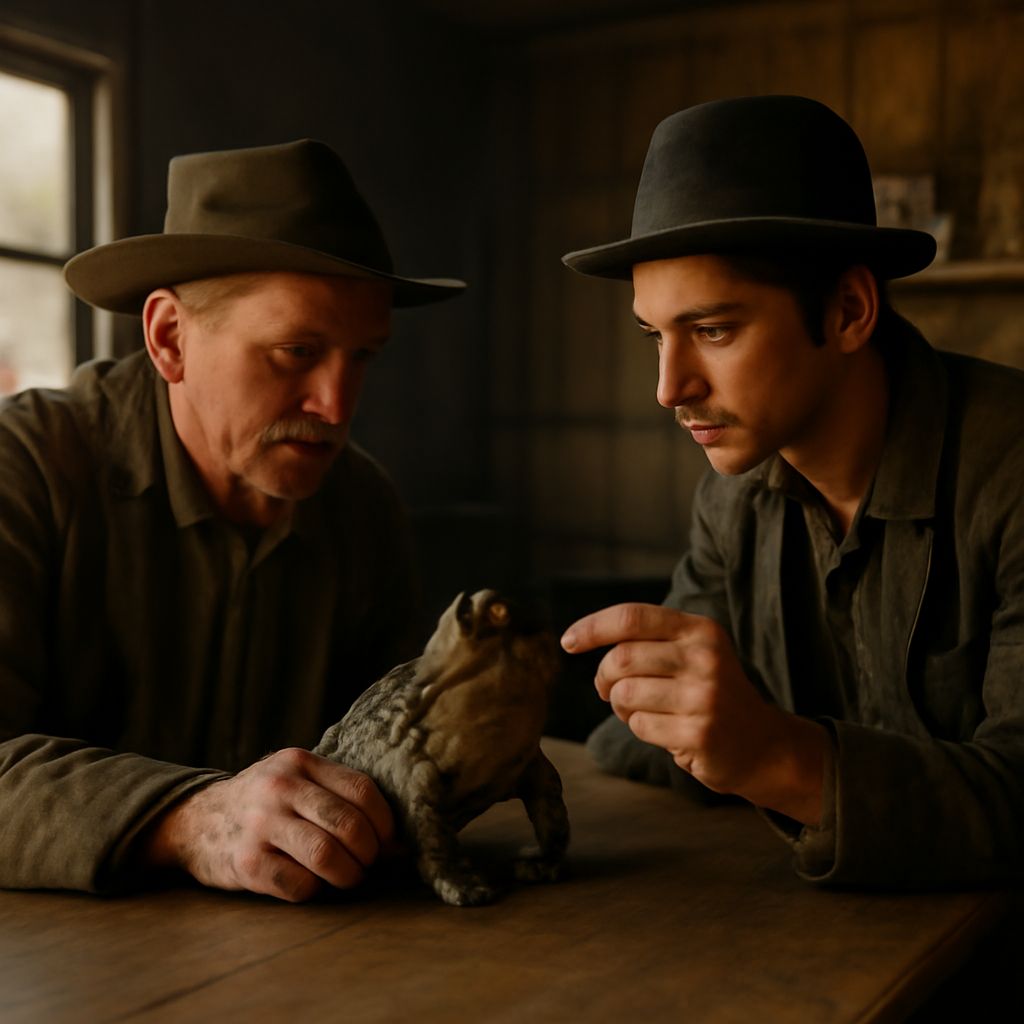
For a quick account of Mark Twain’s celebrated Calaveras County frog story, follow two contests: Jim Smiley’s bet on an animal and a visitor’s struggle to escape a storyteller. This summary of the jumping frog tale explains the trick, then shows why Simon Wheeler’s delivery makes the trick funnier.
The Jumping Frog of Calaveras County: A Visitor Meets Wheeler
The outer story begins when a narrator visits Simon Wheeler to ask about a man named Leonidas W. Smiley. A friend has sent him on the errand. The visitor suspects the friend invented the inquiry as a practical joke, knowing it would prompt Wheeler to tell a long story about another man, Jim Smiley.
Wheeler seats the visitor in a corner and begins. He gives a detailed account in a serious manner, as though every part deserves attention. The listener wants information about Leonidas; Wheeler supplies an abundance of information about Jim. The visitor’s growing suspicion and Wheeler’s unhurried confidence make the frame a comedy of mismatched purposes.
Jim Smiley will bet on almost anything
In Wheeler’s account, Jim Smiley is eager to wager on nearly any outcome. He has a slow-looking mare that nevertheless wins races, and a small bulldog, Andrew Jackson, whose fighting style surprises opponents. The dog usually waits until he can seize an opponent’s hind leg. When matched with a dog that has no hind legs, he cannot use his usual tactic and loses; Wheeler describes the defeated animal’s distress before its death.
The animal stories establish a pattern before the frog appears. Smiley likes an unlikely contender, and Wheeler takes pleasure in describing the details. The dog’s ending also gives the humor a sharper edge than a simple string of harmless pranks. Wheeler tells it with the same earnest attention he gives the rest of his reminiscence.
A trained frog meets a dishonest stranger
Smiley catches a frog, names him Dan’l Webster, and spends months teaching him to jump. The jumping frog of Calaveras County becomes his prized contender; Smiley carries him in a box and looks for a wager. A stranger doubts that Dan’l is extraordinary. Smiley offers to bet that his frog can outjump any other frog in the county.
The stranger says he has no frog, so Smiley goes to catch one for him. Left alone with Dan’l, the stranger feeds the animal quail shot with a teaspoon. When Smiley returns, the two frogs are set down for the contest. The stranger’s frog jumps; Dan’l stays put. The stranger collects the forty-dollar bet and leaves.
Smiley is puzzled by his frog’s weight. When he turns Dan’l over, the shot comes out, revealing the deception. He runs after the stranger, but does not catch him. The celebrated jumping frog of Calaveras County summary ends the wager with a reversal: a man who knows animals and betting has overlooked the person holding his frog.
Why the telling matters
A summary of Twain’s Calaveras County frog story can explain the result in a few sentences. Wheeler takes a longer route, filling it with betting habits, animal histories, and precise little observations. His pauses and detours make the visitor wait for a point that may have nothing to do with the original question.
Wheeler’s manner is crucial. The visitor describes him as earnest and sincere, not as a man obviously signaling a punch line. His seriousness lets the listener notice the absurdity. This account of the celebrated Calaveras County frog also shows how confidence can invite deception. Smiley’s confidence is comic in its own way: he knows Dan’l can jump, and so gives his opponent an opportunity to make sure the frog cannot.
The story has also appeared under the title “Jim Smiley and His Jumping Frog”. The University of Virginia’s text identifies that as the title of the 1865 version. In the later framing, Jim’s contest belongs to Wheeler’s account; the annoyed visitor belongs to the outer narrative. Keeping those voices distinct helps the joke land.
Read the frame and the tale aloud
For a spoken retelling of the Calaveras County jumping frog story, give the visitor a clear objective: get an answer and leave. Give Wheeler a different one: tell the story properly, however long it takes. You can use a slight change in pace and focus to distinguish them without turning either man into a cartoon.
At the end, Wheeler is briefly called away. The visitor uses the opening to leave, but Wheeler begins another story as he goes. Read that interruption as the visitor’s chance of escape, not as part of Smiley’s bet. The frog has already lost; the listener is still trying to win his freedom.