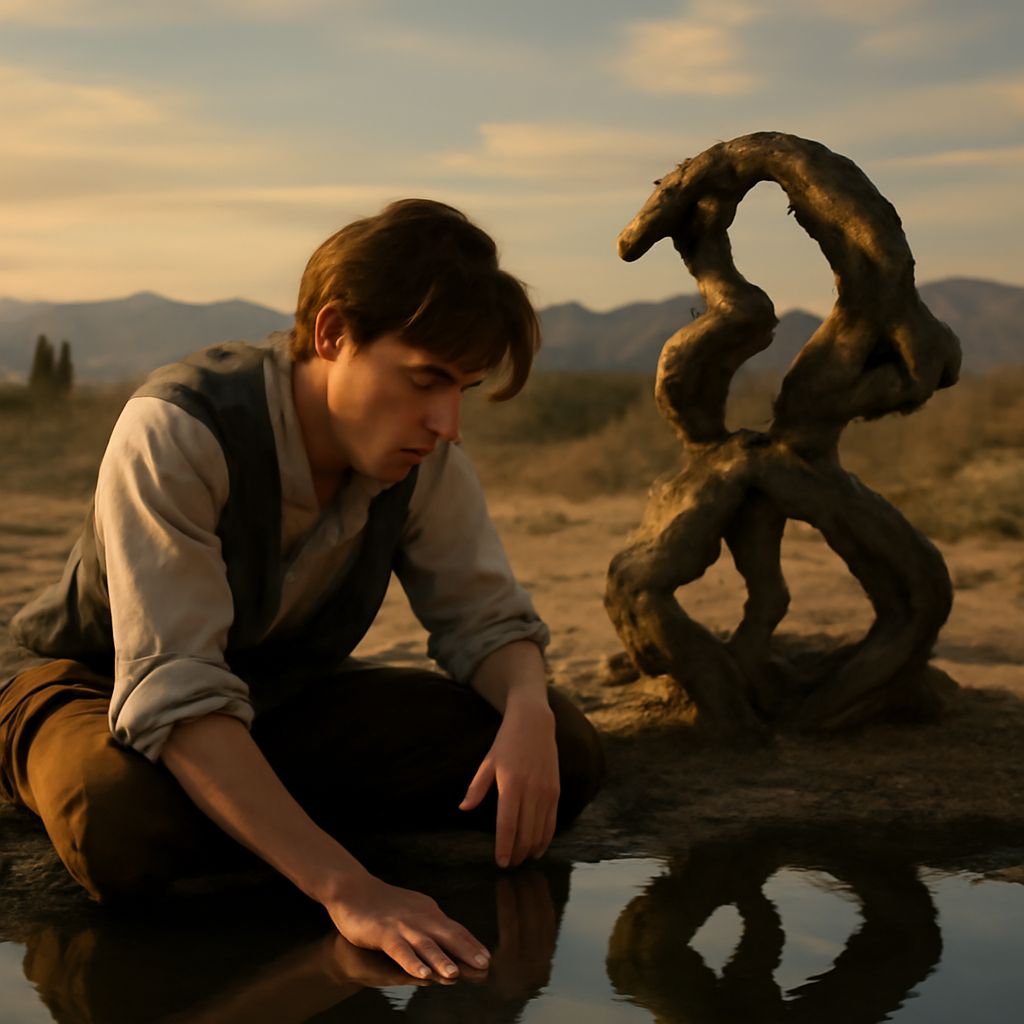
Ovid’s Metamorphoses follows a world in constant change, from its creation to the age of Rome. An overview of Metamorphoses needs this broad chronological map. This brief account of Ovid’s Metamorphoses tracks transformations rather than the journey of one hero. Gods, humans, animals, trees, and stones share the stage. Nobody stays on it for long.
The poem has 15 books, written in Latin verse. Its stories connect through families, places, journeys, and storytellers who stop to tell other stories. A guide to Ovid’s poem can trace that movement, but the changes in voice matter as much as the sequence. Listen for who wants something, who has the power to take it, and who must live with the result.
Metamorphoses Ovid Summary: From Chaos to Human Lives
In Book 1, the world takes shape from a confused mass. Land, sea, and sky find their places. The poem moves through ages of humanity, from a golden age to an iron age marked by violence and greed. Jupiter sends a flood, but Deucalion and Pyrrha survive. Following divine instructions, they throw stones behind them; the stones become people. Humanity begins again with hard material and a hard future.
The scale soon narrows. Apollo pursues Daphne, who wants to escape him. She calls on her river-god father for help and becomes a laurel tree. Apollo claims the laurel as his own symbol. The change saves Daphne from capture, yet it also takes away her human form. A performer can hold both facts in mind: deliver her plea as an urgent choice, then allow the physical change its own pace. The tree is an answer, and a cost.
Desire, Power, and Stories Within Stories
The poem often gives powerful figures the freedom to pursue what they want. Others pay for it. Jupiter assaults Io, then changes her into a cow; Juno has the many-eyed Argus guard her. Mercury eventually kills Argus, and Io later regains human form. Her altered body makes even communicating her identity difficult. When reading the scene, notice how a change in body changes the means of speaking.
A story can also interrupt another story. As Mercury tries to lull Argus to sleep, he tells him about Pan’s pursuit of Syrinx, who becomes reeds. Wind through the reeds produces sound, and Pan makes pipes from them. The tale belongs to Mercury’s immediate task as well as to the larger pattern of pursuit and transformation. A voice actor can distinguish Mercury’s purpose from the emotions of the characters in his story: he is telling it to accomplish something.
The consequences are not always caused by pursuit. In Book 2, Phaethon asks to drive the chariot of the sun as proof of his father’s promise. He cannot control the horses; the earth suffers from the heat, and Jupiter strikes him down. His sisters grieve and become trees, their tears hardening into amber. A desire to prove one’s identity reaches far beyond the person who first feels it.
Love, Loss, and the Singer’s Voice
In Book 10, Orpheus descends to the underworld after his wife Eurydice dies. His song moves its rulers to let her follow him back, on condition that he does not look at her before they reach the upper world. He looks back too soon, and she is lost again. The scene gives a reader a practical assignment: let the need to see her build before the turn. The action takes an instant; the fear behind it has had time to grow.
Orpheus then becomes a storyteller within the poem. Among his tales are those of Pygmalion, who falls in love with a statue brought to life, and of Venus and Adonis, whose death leads Venus to create an anemone from his blood. The singer’s own loss gives the following stories a context, though each has its own shape and speaker. Mark where the outer narrator stops and Orpheus begins. You can change focus without inventing a different character voice for every line.
From Troy to Rome
Later books move through the Trojan War, Aeneas’s journey, and stories connected with Italy and early Rome. The movement is broadly chronological, but each stop opens onto other lives. In Book 15, the philosopher Pythagoras argues that forms continually change and that souls pass between bodies. His speech gives an explicit idea of change within a poem that has already shown many kinds of it: some beautiful, some terrible, and some both.
Near the end, Venus carries Julius Caesar’s soul heavenward, where it becomes a star. The poem turns toward Augustus and the Roman present, then closes with the poet’s claim that his work will outlast his body. The world has changed from chaos into an empire with its own stories of power. The storyteller expects a longer life than the flesh.
A metamorphoses summary is most useful as a route through those linked episodes. Read Metamorphoses, an Ovid summary beside you, and follow one chain of transformations before returning to the full episode. Use the book-by-book map to choose a path through the poem. Note the speaker, the listener, the desired outcome, and the point where the balance of power changes. Read the same passage aloud twice: first to make the events clear, then to make the speaker’s intention clear. Compare the recordings and keep the choices that reveal the story.
Is there one hero? No. Change is the thread; the people caught in it take turns speaking.