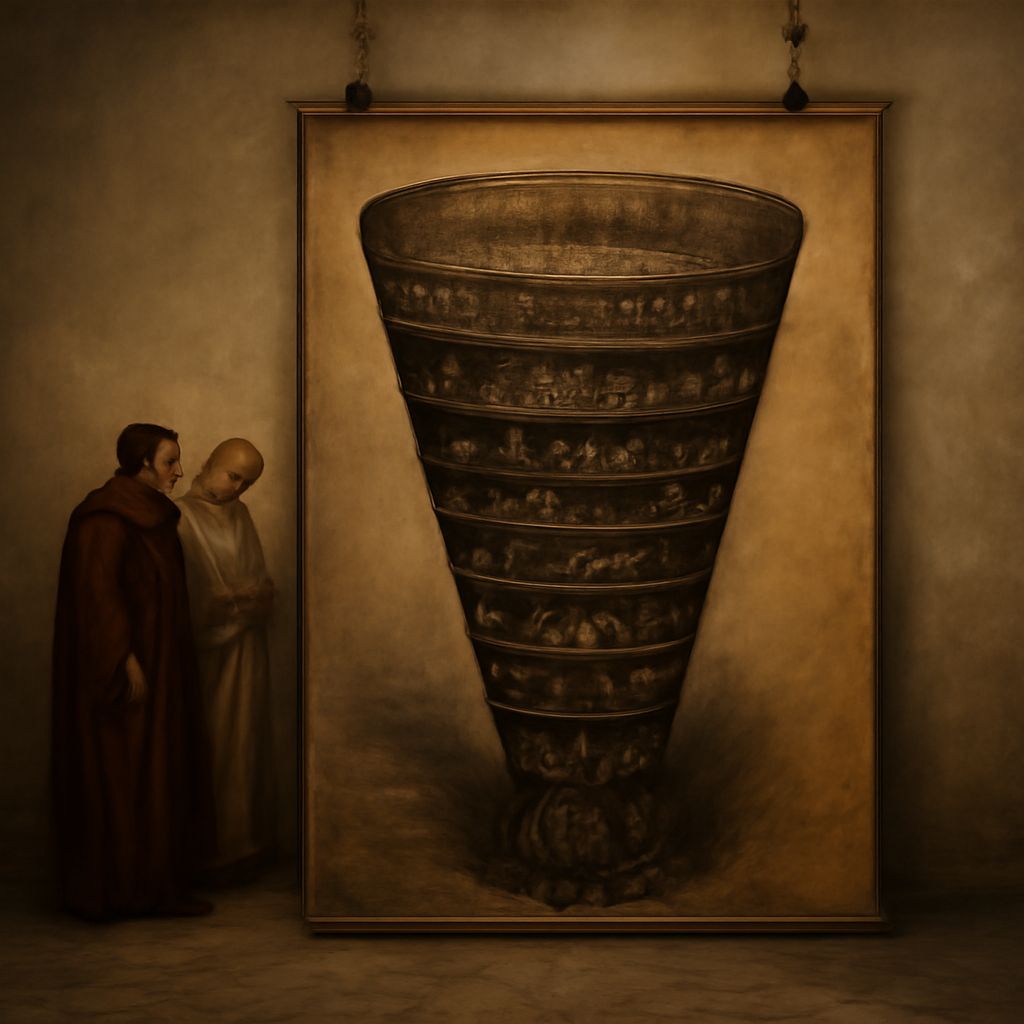
Begin with a lost traveler, not a map of punishments. In this summary of Dante’s Inferno, the pilgrim enters a dark wood, meets the Roman poet Virgil, and descends through Hell before finding a way out. Each encounter tests how he responds to suffering and judgment.
Dantes Inferno Summary: The Guide and the Journey
The poem’s traveler is a character called Dante; Dante Alighieri, the poet, shapes the whole journey and its judgments. Keeping those roles distinct helps when the pilgrim feels pity or confusion. The author can let a character react in the moment while the larger poem asks the reader to examine that reaction.
Virgil arrives when the pilgrim cannot find a safe route out of the wood. Sent to help him, he leads Dante toward Hell and through its depths. This Dante Inferno summary follows the first part of the Divine Comedy. The larger work continues through Purgatorio and Paradiso, but the immediate task is to understand what the travelers see below.
The upper circles: Desire and its consequences
Before entering the numbered circles, Dante encounters souls who refused to take a side. Then the travelers cross the Acheron and reach Limbo, the first circle. Here are virtuous people who lived without baptism or knowledge of Christianity, including Virgil. They are not physically tortured, but live without hope of seeing God.
In the second circle, a storm carries souls punished for lust. Francesca tells Dante how she and Paolo were drawn together while reading a romance. Her account moves the pilgrim so deeply that he faints. The scene invites compassion while placing her story within the poem’s moral order. Those two responses need not sound identical when a performer reads the passage.
This overview of Dante’s Inferno continues past circles associated with gluttony, avarice and prodigality, and anger. Their settings turn inner habits into visible conditions: the angry struggle in the muddy Styx, while others lie beneath its surface. Virgil explains, guides, and sometimes reassures; the pilgrim has to keep moving even when the sights disturb him.
Lower Hell: Violence, fraud, and betrayal
Beyond the walls of Dis, the sixth circle contains heretics in burning tombs. The seventh is divided into regions for different forms of violence. In the eighth, called Malebolge, separate trenches hold different kinds of fraud. The ninth is a frozen region for traitors. This retelling of Inferno by Dante Alighieri shows how the arrangement reflects the poem’s moral reasoning: deliberate violence and especially the misuse of reason in fraud and betrayal carry the travelers deeper.
A Dantes Inferno summary should make room for Ulysses in the eighth circle. Enclosed in flame with Diomedes, he tells of a final voyage beyond the limits set for human sailors. His stirring account of exploration is compelling, yet it comes from a soul placed among fraudulent counselors. A reader can hear both the attraction of his speech and the judgment represented by his setting.
At the bottom, Satan is trapped in ice and chews Judas, Brutus, and Cassius. Dante and Virgil climb down his body, pass the earth’s center, and eventually emerge to see the stars. The exit ends this part of the journey; the pilgrim’s further ascent belongs to the next part of the Comedy.
How contrapasso makes judgment visible
Contrapasso describes a meaningful relationship between a soul’s earthly conduct and its punishment. The connection may resemble or contrast with the sin. In the storm of the lustful, for example, the ceaseless motion can be read as an image of passions carrying people away. In the frozen depths, the stillness of ice gives betrayal a cold and immobilizing setting.
The design is poetic and theological rather than a neutral list of modern moral categories. Dante the poet brings together Christian ideas, classical figures, and people from his own political world. The University of Leeds guide outlines how these traditions enter his imagined Hell.
Read the encounters as conversations
Choose a passage and mark who knows what. Virgil often understands the landscape; the pilgrim encounters it for the first time; a soul may have a carefully shaped story to tell. Give each speaker an objective before choosing a voice. Francesca may seek understanding, while the pilgrim listens and reacts. Ulysses addresses an audience with a powerful account of his voyage.
Read once for the argument and once for the relationship between speakers. Let a pause mark a new realization rather than every line ending. When the pilgrim responds, make the response arise from what was just heard. The journey becomes a series of human encounters inside a carefully ordered world.