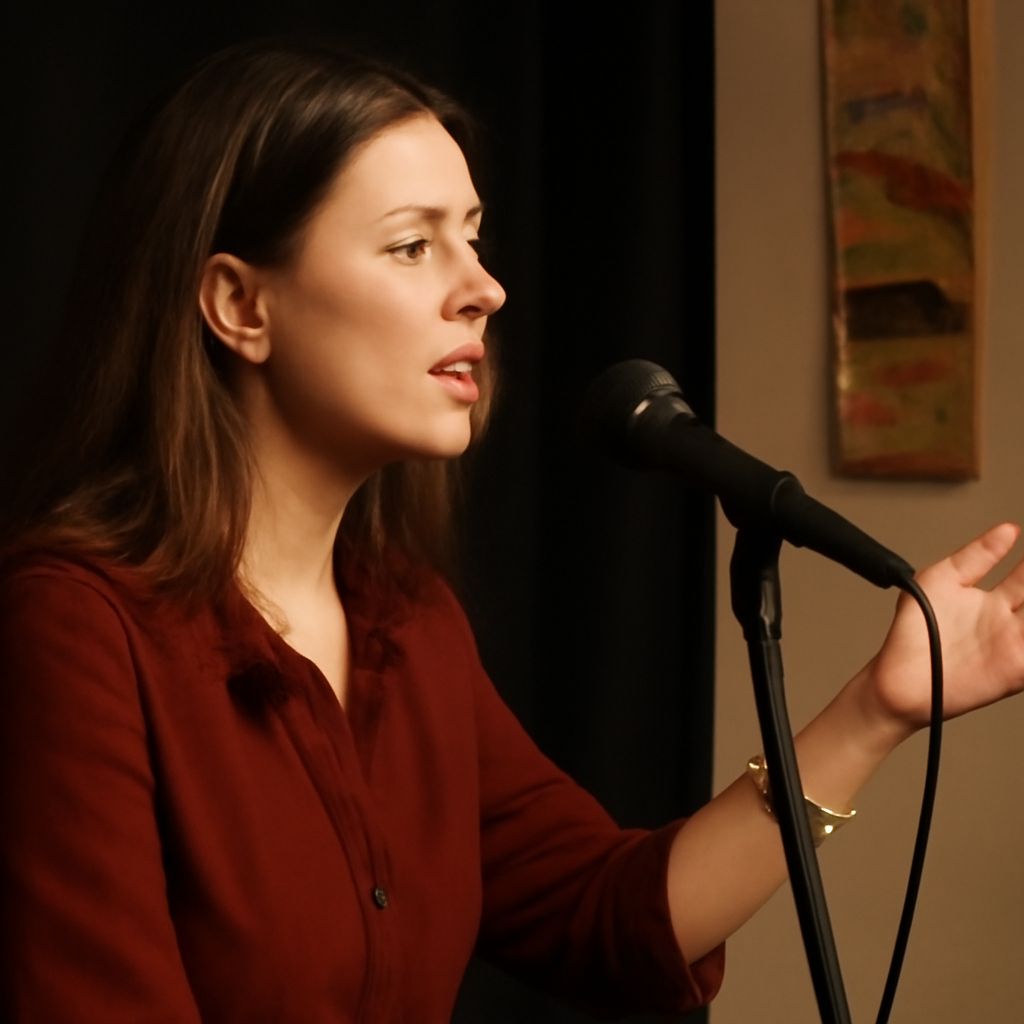
You have three minutes at a microphone and a page full of strong lines. The problem is making an audience follow the thought the first time it hears it. Studying examples of slam poetry can show you how repetition, shifts in pace, and a clear point of view carry an argument across a room.
The slam poem examples below come from recorded competition performances: one individual piece and one team piece. They do different work. Listen for the change in each argument before borrowing a technique. A pause or a repeated phrase matters because of what it helps the audience understand.
Slam Poem Examples: A Private Story at a Public Microphone
Neil Hilborn, “OCD”
Neil Hilborn performed “OCD” at the 2013 Rustbelt Regional Poetry Slam; the linked recording documents his individual-finals performance. The poem describes obsessive-compulsive experiences alongside a relationship. Early on, the speaker calls the person he meets the first beautiful thing he has become stuck on. The word “stuck” connects attraction with an experience that will become more painful as the relationship changes.
The piece uses repetition in its language and delivery. Details about checking and returning to actions establish a pattern; the relationship then changes how the audience hears that pattern. What first seems like a private habit becomes part of a story about intimacy and loss. The performance is one person’s account, not a template for how everyone with OCD speaks or behaves.
Listen to how a repeated phrase occupies time. It can make a listener wait with the speaker, then acquire a different emotional weight when the relationship no longer offers the same response. Notice, too, where the audience reacts. The performer and room share a live event, but the poem does not stop being personal because people are listening.
For your own practice, write a line that can return twice with a changed meaning. Place one concrete event between its first and second appearances. Read both versions to a partner. Ask what changed for the speaker. Do not imitate another person’s symptoms to create dramatic effect.
A Team Poem That Widens the Frame
Belissa Escobedo, Rhiannon McGavin, and Zariya Allen, “Somewhere in America”
The Los Angeles team performed “Somewhere in America” in the 2014 Brave New Voices finals. The linked teaching page identifies the performers and includes the recording and a transcript. The poem begins with school standards and the lessons students learn beyond a syllabus. It then moves through contrasts involving censorship, inequality, racism, and sexual violence.
The recurring phrase “somewhere in America” gives the audience a recognizable return point. Each return introduces another place or situation, so the argument expands rather than staying with a single example. The opening claim about lessons gains force as the piece shows what young people may learn from institutions, silences, and unequal treatment.
The three performers share the work of address. Listen for how the poem moves between individual voices and collective emphasis, and watch how a handoff keeps one thought connected to the next. The pace and intensity serve a sequence of examples. When practicing with a group, mark where the listener needs a beat to absorb a contrast before another speaker enters.
The poem includes difficult subjects. If you use it in a classroom, preview the material and give listeners context. Treat its statements as the speakers’ argument and investigate specific factual claims separately; the power of a performance does not make every claim self-verifying.
What Makes a Slam Recording Different?
A poetry slam is a competitive event in which performances are judged, often by people selected from the audience. Rules vary by event. Spoken word is a broader term for work made to be heard; a performance at an open mic or on a studio recording is not automatically a slam entry. Both slam poetry examples are spoken-word performances with identifiable competition settings.
The best slam poetry for a particular room may be quiet, funny, urgent, or some combination. A crowd’s response is part of the live setting, but applause alone cannot tell you whether a poem’s argument is clear. Listen to the recording again and note what happens just before a reaction: a contrast, an image, a change of speaker, or a pause may have given the audience time to recognize the point.
Practice With an Argument of Your Own
Write six lines about one situation you know. Use Hilborn’s approach to repetition: give one phrase a second meaning after the situation changes. Or try the team poem’s structure: return to a phrase while each example widens the claim. Mark one place to slow down and one place to leave space for a listener.
Record a take, then ask someone to summarize the argument without seeing the page. If they miss the turn, revise the order or give that moment more time. The goal is not to reproduce either performance. It is to make your own thought audible on its first journey across the room.