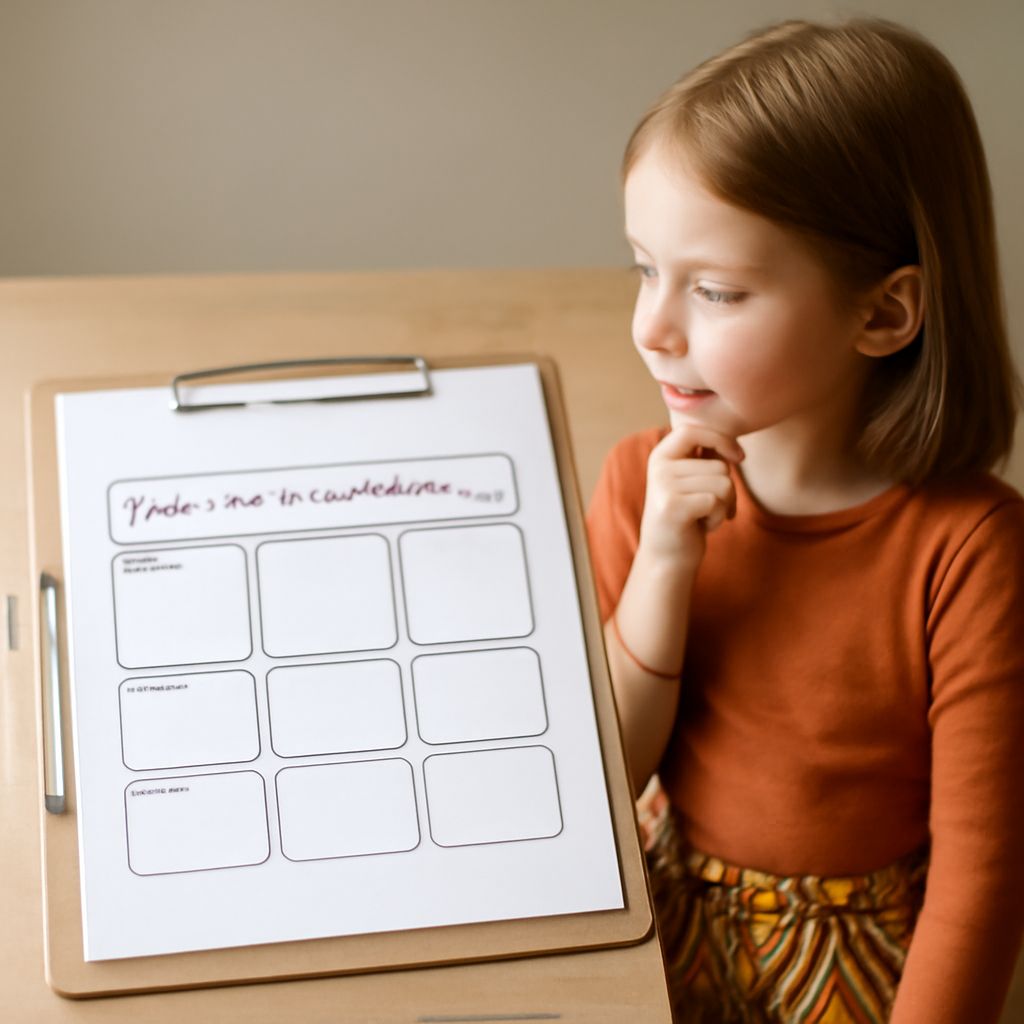
A narrative writing graphic organizer helps a writer turn a personal experience into a complete story. The organizer below moves from the narrator and setting to the desire, conflict, sequence of events, turning point, consequence, and meaning. It also includes a completed first-person example so you can see how planning choices become a draft.
Use one or two sentences for each field before drafting. A strong plan does not record every detail. It selects the details that make the change in the story clear.
Narrative writing graphic organizer: narrator, setting, desire, conflict, events, turning point, consequence, and meaning
Complete the fields in order. Keep the story focused on one important moment or short sequence of related moments.
- Narrator: Who tells the story? Write the narrator’s name, role, and point of view. For a first-person narrative, use “I” or “we” and state what makes this narrator connected to the event.
- Setting: Where and when does the story happen? Add specific details that affect the action, such as a crowded hallway, a rainy afternoon, or the final ten minutes before a deadline.
- Desire: What does the narrator want at the beginning? State the immediate goal, not a broad wish. “I wanted to submit my sketchbook before four” is more useful than “I wanted to succeed.”
- Conflict: What blocks the desire? Identify the problem, pressure, mistake, disagreement, or decision that prevents the narrator from getting what they want easily.
- Events: List three to five actions in the order they occur. Include what the narrator notices, says, tries, or chooses. Each event should make the next event possible.
- Turning point: What decision, discovery, or change shifts the story? This is often the moment when the narrator stops repeating an unsuccessful action and takes a new approach.
- Consequence: What happens because of the turning point? Include the immediate result, even if the narrator does not get everything desired.
- Meaning: What does the narrator understand afterward? This reflection should grow from the events. Avoid a lesson that could fit any story; explain what this particular experience changed or clarified.
Before drafting, check the sequence. The desire should create a reason to act, the conflict should interrupt that action, and the turning point should lead to a visible consequence. If the events could occur in any order, add time markers or a clearer cause-and-effect connection.
Narration: a practical literary definition and the narrator’s job
The practical literary definition of narration is the way a story’s events are presented through a narrator’s voice, viewpoint, and selection of details. Narration answers three basic questions: who is telling the story, what does that teller know, and how does the teller interpret what happens?
The narrator’s job is not simply to report events. The narrator guides the reader through the sequence, reveals important observations, communicates reactions, and helps the reader understand why the experience matters. A narrator can be a character in the story or an outside voice.
In first-person narration, the character tells the story using “I.” This gives the reader direct access to the narrator’s thoughts, memories, physical sensations, and opinions. It does not give the narrator unlimited knowledge. The narrator cannot automatically know another character’s private thoughts, unseen actions, or future choices.
Those limits can make a first-person story more convincing. Instead of writing, “Eli felt guilty about moving my book,” a first-person narrator might write, “Eli lowered his eyes and rubbed a streak of blue paint from his thumb.” The narrator can observe the action and interpret it, but the reader can still decide what Eli feels.
First-person narration also allows an unreliable or mistaken interpretation. A narrator may assume that someone took the book, misunderstand a silence, or remember an earlier event imperfectly. The organizer should record what the narrator knows at each stage, not what the author knows from outside the story.
Completed first-person example: how access and limits shape the plan
The following plan uses the organizer for a short school narrative about a missing sketchbook.
- Narrator: I am an eighth-grade art student who needs to submit a sketchbook. I tell the story after the event but describe what I noticed and thought at the time.
- Setting: The art room and hallway at 3:35 on a rainy Thursday. The submission deadline is 4:00, and most students have already left.
- Desire: I want to submit my sketchbook on time for a class portfolio review.
- Conflict: My sketchbook is missing from the stool where I left it. I first suspect that someone took it, but I have no proof.
- Events: I search the stool and my cubby, retrace my steps from lunch, notice wet footprints near the supply sink, and ask Eli whether he saw the book.
- Turning point: Instead of accusing Eli, I ask what happened. He explains that he moved the sketchbook after water spilled near the stool.
- Consequence: I find the book on a drying rack with one smeared page. I submit it at 3:58, and my teacher accepts it.
- Meaning: I learn that an accusation based on fear can hide useful information. Asking for an explanation helps me solve the problem without damaging trust.
The first-person viewpoint controls the information in this plan. The narrator knows that the sketchbook is missing, remembers where it was left, and notices the footprints. The narrator does not know Eli’s reason for moving it until Eli explains. The plan should not state that Eli intended to help before that conversation.
Short draft: At 3:35, I lifted the stool cushion and found nothing but a dried glue stick. My sketchbook had been there when I went to lunch, and Ms. Chen collected portfolios at four.
I searched my cubby, then checked the table where I had sharpened my pencils. Rain tapped the windows while I hurried through the emptying room. Near the supply sink, I noticed a line of wet footprints. They stopped beside Eli’s worktable.
“Did you move my sketchbook?” I asked.
Eli looked at the sink. “The water cup tipped over,” he said. “I put your book on the drying rack.”
I found it under a paper towel. One page had a blue smear across the corner, but the drawings were still visible. I wanted to blame Eli when I saw the footprints. Instead, I had asked first, and now I understood what had happened. I handed Ms. Chen the damp book at 3:58. The page was imperfect, but it was mine, and I had finished the problem without turning a guess into an accusation.
From organizer to draft and revision: preserve access, limits, and reflection
Turn the organizer into a draft by giving each stage a clear place in the narrative.
- Open with the setting and desire. Establish where the narrator is, when the moment occurs, and what the narrator needs or wants. A concrete deadline or physical detail can create immediate pressure.
- Build the conflict through selected events. Show the narrator trying something, encountering a setback, and trying again. Use details the narrator could actually notice through sight, sound, touch, memory, or conversation.
- Slow down at the turning point. Give the key decision or discovery enough space for the reader to understand the narrator’s thought process. This is usually the most important moment in the story.
- Show the consequence and meaning. Explain what changed in the situation, then connect that result to the narrator’s reflection. The meaning should not replace the scene; it should follow from it.
During revision, check first-person access. Replace information the narrator could not know with an observable action, spoken line, remembered detail, or careful inference. For example, revise “My friend was embarrassed” to “My friend pulled her sleeve over her hand and stopped looking at me.” If the narrator later learns the truth, place that knowledge after the conversation or discovery that provides it.
Check the sequence by marking each event with a time word such as first, afterward, while, or finally when the order is not already clear. Remove events that do not increase pressure, reveal character, or lead toward the turning point.
Check the conflict and consequence together. A weak draft may describe a problem but end without showing what the narrator’s choice caused. Add the immediate result: a conversation changes, a goal is reached or missed, an object is recovered, or a relationship feels different.
Finally, test the reflection against the plan. If the meaning could be copied into any personal narrative, make it more specific to the narrator’s decision. “I learned to be careful” is broad. “I learned to ask for an explanation before treating my fear as evidence” grows directly from the completed story.