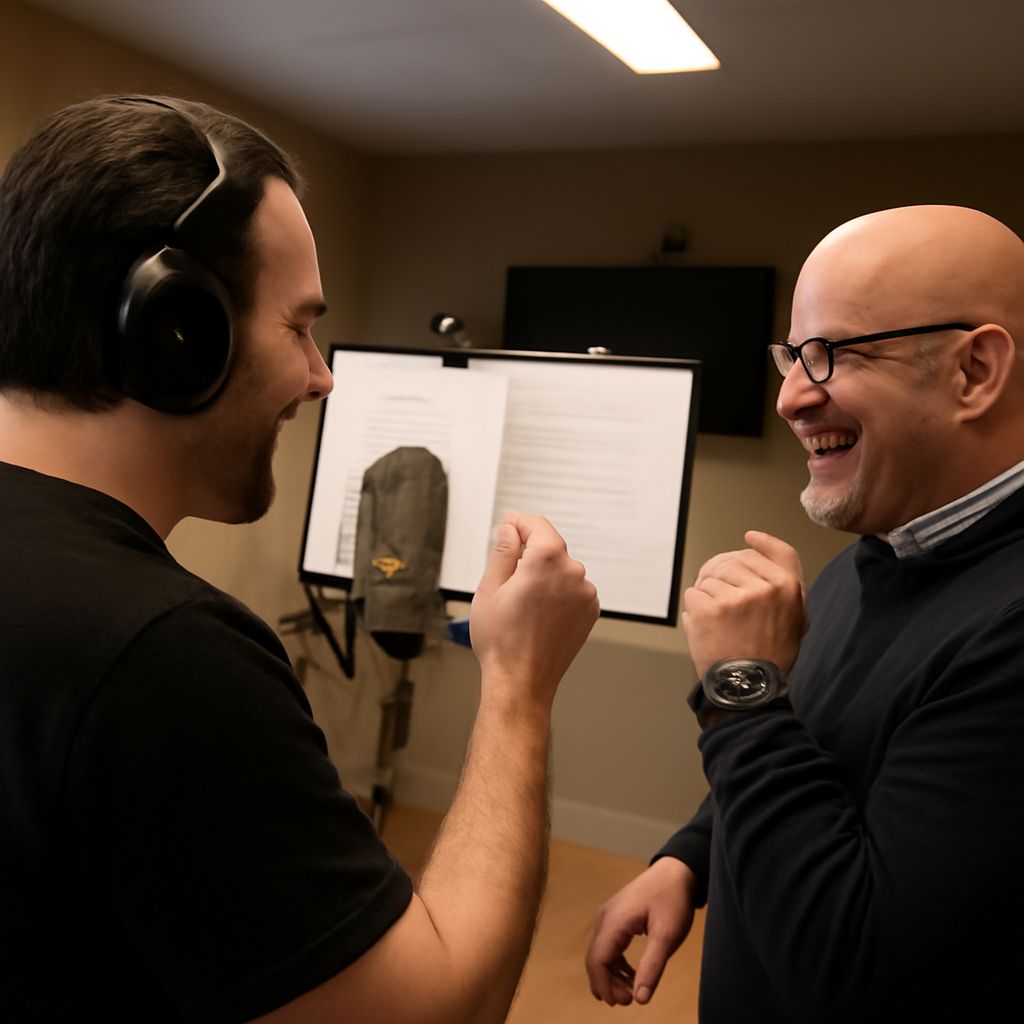
These voice acting scripts give beginners focused practice for commercial, narration, informational, and character reads. Each exercise includes an intended audience, tone, approximate timing, delivery variations, and a listening check.
Record every take from the same starting position. Use one neutral take first, then repeat the script with the suggested adjustment. The goal is not to create a different performance each time. The goal is to hear how one controlled change affects pace, clarity, emphasis, or consistency.
How to use voice acting scripts for repeatable practice
- Prepare the copy. Mark one or two words for emphasis, draw a slash where a short pause belongs, and underline any phrase that needs extra clarity. Avoid marking every word. Too many instructions can make a read stiff.
- Record a baseline take. Read the script naturally without correcting yourself mid-sentence. Note the total time and any words that felt difficult.
- Change one delivery quality. Try a faster pace, a warmer tone, a firmer final line, or a more conversational rhythm. Keep the wording and microphone position unchanged.
- Review without looking at the script. Listen once for the overall impression. Listen again for a single technical issue, such as rushed phrasing or inconsistent volume.
- Repeat with a specific target. Make one correction and record another take. Stop when the target improves without creating a new problem.
A useful practice session takes 10 to 15 minutes. Choose one script, record three takes, and write down one strength and one adjustment after listening. For most beginner reads, a comfortable pace falls between 130 and 160 words per minute. Commercial copy may move faster, while instructional narration often needs more space.
Use these listening checks after every take:
- Pace: Do important ideas have enough time to register, or do sentence endings rush?
- Clarity: Are consonants audible without sounding over-pronounced?
- Emphasis: Does the stress support the meaning, or do too many words sound equally important?
- Consistency: Do volume, tone, distance from the microphone, and energy remain stable from beginning to end?
Practice voice over scripts for commercial and promotional delivery
Script 1: Bright product commercial
Audience: Busy commuters and students
Tone: Upbeat, friendly, confident
Approximate read time: 25 seconds
Meet the morning mug that keeps up with your day. The MetroSip travel cup keeps coffee hot, fits your car’s cup holder, and seals tight before the first train leaves the station. Choose a color that matches your routine, fill it once, and head out ready. MetroSip. A better start, wherever you are.
Delivery variations: Begin with a bright, immediate lift on “Meet the morning mug.” For a retail version, increase the energy and shorten the pauses. For a premium version, slow the middle section, soften “seals tight,” and let the brand name land with calm confidence.
Listening check: Make sure “keeps up with your day” sounds like a benefit rather than a slogan. Check that “hot,” “fits,” and “seals” remain distinct at a quicker pace. The final brand name should have slightly more space around it than the rest of the copy.
Script 2: Calm service promotion
Audience: Homeowners comparing energy services
Tone: Reassuring, practical, trustworthy
Approximate read time: 30 seconds
Your home works hard. Your energy plan should work smarter. With Northline Power, you get clear monthly pricing, helpful usage updates, and support from people who speak plainly. Set up your plan in minutes, then see where your energy goes without sorting through confusing statements. Northline Power. Simple service for the place you call home.
Delivery variations: Read the first sentence with measured authority and a slight pause between the two short clauses. In one take, sound like a knowledgeable advisor. In another, use a warmer, neighborly tone while keeping the pace steady. Do not turn “simple service” into a dramatic slogan; it should feel like a dependable promise.
Listening check: Listen for a level volume across the longer middle sentence. Check whether “clear,” “helpful,” and “plainly” receive enough emphasis to communicate the service benefits. If the final line sounds sentimental, reduce the pitch movement and use a firmer ending.
Script 3: Direct promotional call to action
Audience: Adults considering a weekend fitness class
Tone: Energetic, motivating, inclusive
Approximate read time: 20 seconds
Two days. One fresh start. Join Harbor Studio this Saturday for a full-body class built for real schedules and every experience level. Move at your pace, meet your next goal, and leave with energy to spare. Reserve your place today at Harbor Studio.
Delivery variations: Perform the first two lines with crisp, separated beats. Then try a smoother conversational version that connects “real schedules” and “every experience level.” For a radio-style take, build energy toward “Reserve your place today.” For a social video, keep the delivery intimate and close.
Listening check: Count whether the short opening phrases sound intentional rather than choppy. Check that “every experience level” remains welcoming. The call to action should be easy to understand on the first listen, with no swallowed sounds at the end.
Narration and informational explainer scripts for clear, measured reads
Script 4: Documentary-style narration
Audience: Viewers watching a short nature documentary
Tone: Observant, composed, quietly vivid
Approximate read time: 40 seconds
Before sunrise, the marsh appears almost motionless. Beneath the surface, however, the tide is already moving through narrow channels, carrying minerals, seeds, and small organisms into the reeds. As daylight spreads across the water, herons leave their overnight perches. They move slowly at first, conserving energy before the morning hunt begins. In this habitat, patience is not stillness. It is a way of staying ready.
Delivery variations: Start with a restrained documentary read, allowing the images to carry the emotion. Repeat it with more warmth and a slightly slower pace. In a third take, make the final two sentences more reflective without becoming theatrical.
Listening check: Give “almost motionless” enough space to contrast with “already moving.” Keep the technical list—“minerals, seeds, and small organisms”—evenly paced. Check that the final sentence sounds like a clear insight, not a separate announcement.
Script 5: Product explainer
Audience: New users learning a scheduling application
Tone: Clear, patient, encouraging
Approximate read time: 35 seconds
To schedule a meeting, open your calendar and select a time that works for you. Add the people you want to invite, then choose “Find a time.” The calendar highlights the hours you share. Select one of those open spaces, add a brief note, and press “Send.” If plans change, open the meeting again and choose “Reschedule.” Your guests receive the update automatically.
Delivery variations: Use a neutral instructional read first. Then perform the script as if you are guiding someone who has never used the application. Add a small pause before each action: “Add the people,” “choose Find a time,” and “press Send.” A third take can use a slightly faster pace, but only if each instruction remains distinct.
Listening check: Confirm that every action is audible and in the correct order. Product labels should receive clean emphasis without sounding exaggerated. Listen for a consistent pitch across the list of instructions. If the final sentence drops too quickly, repeat it with a deliberate pause before “automatically.”
Script 6: Public information announcement
Audience: Residents receiving a community recycling update
Tone: Helpful, precise, community-focused
Approximate read time: 30 seconds
Starting Monday, glass containers can be placed in the blue recycling bin. Rinse each container, remove the lid, and place bottles and jars loosely inside. Do not include drinking glasses, mirrors, or light bulbs. Collection begins at seven in the morning, so set your bin out by six. For a complete list of accepted materials, visit the community services page.
Delivery variations: Read it once in a straightforward announcement style. Then use a warmer community tone while preserving the instructions. In a third take, emphasize the exclusions more firmly so listeners can separate accepted materials from items that do not belong in the bin.
Listening check: Make sure “starting Monday” and “by six” are unmistakable. Keep the accepted-item list and exclusion list rhythmically separate. Check that the final web instruction does not sound like an afterthought.
Voice actor script exercises for character delivery and self-review
Script 7: Curious young inventor
Audience: Children listening to an animated adventure
Tone: Curious, quick-thinking, optimistic
Approximate read time: 30 seconds
Okay, the map says the door is here, but the wall says otherwise. That is not a problem. It is a clue with excellent timing. Give me the lantern, three buttons, and one minute. If I am right, this staircase will take us straight to the observatory. If I am wrong, we will discover a very exciting broom closet.
Delivery variations: Keep the character energetic without raising the pitch on every line. Try one take with rapid thought changes and another with a more deliberate, clever rhythm. On “excellent timing,” use dry confidence. On “very exciting broom closet,” allow the humor to sound accidental rather than forced.
Listening check: Verify that the character remains understandable when the pace increases. Check whether the emotional shift from confidence to uncertainty is audible. Keep the voice age, accent, and energy consistent between the first and second halves.
Script 8: Tired but determined space pilot
Audience: Adults watching a science-fiction audio drama
Tone: Controlled, weary, determined
Approximate read time: 35 seconds
We have one approach left before the station closes its outer gates. The engine is holding, the fuel is low, and my navigation screen has stopped pretending to be helpful. I need everyone quiet for ten seconds. Then I need the landing lights on, the west channel open, and a clear path home. We are not waiting for perfect conditions. We are going now.
Delivery variations: Perform the first take with physical fatigue but controlled breathing. In the second, reduce the fatigue and increase leadership. For a more dramatic version, build pressure through the list of instructions, then make “We are going now” firm and quiet rather than loud.
Listening check: Listen for breath noise after the longer sentence. The three instructions should have matching grammatical emphasis and clear separation. Check that the final line changes the character’s energy without changing the vocal identity.
Script 9: Character consistency exercise
Audience: Players following a friendly but secretive shopkeeper
Tone: Welcoming, playful, slightly mysterious
Approximate read time: 25 seconds
Welcome, welcome. You are just in time for the good shelf. The ordinary shelf is over there, beside the ordinary dust. This little box, though, has traveled farther than either of us. I cannot tell you what is inside. I can tell you that it has been waiting for someone with your particular kind of trouble.
Delivery variations: Use a welcoming smile in the opening without making every word bright. Try a more secretive version by lowering the volume on “the good shelf” and slowing before “though.” Then perform it as a shopkeeper who has already guessed the listener’s intentions.
Listening check: Confirm that the character’s vocal placement stays stable across all three takes. Check the contrast between “ordinary” and “this little box.” Make sure the final phrase sounds specific and intentional, not vague because of reduced volume.
Self-review exercise for any voice actor script
Choose one character script and create three recordings. In the first, prioritize pace. In the second, prioritize clarity. In the third, prioritize emotional consistency. Label the files by take number rather than by which one you expect to be best.
- Compare pace: Note whether pauses occur at useful thought breaks or only where breathing becomes difficult.
- Compare clarity: Write down the first word or phrase you had to replay. Practice that phrase alone, then place it back into the sentence.
- Compare emphasis: Identify the three words that carry the character’s intention. If you emphasized more than three, reduce the number.
- Compare consistency: Check vocal age, energy, accent, volume, and microphone distance. A character can change emotion without losing its recognizable voice.
Finish by recording one final take without listening between lines. Use the strongest pace, clearest diction, and most consistent character choices from the earlier recordings. This makes the practice repeatable and shows which improvements remain available without constant correction.